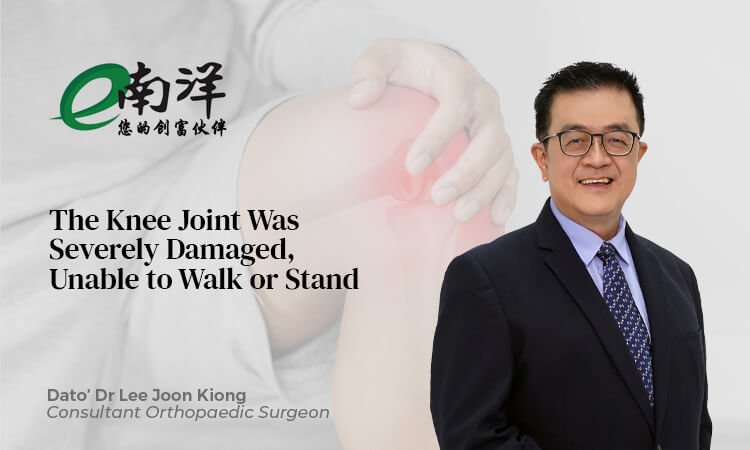

The knee joint was severely damaged, unable to walk or stand!
Mrs. Ying, 75 years old, came to the clinic with her children about
two months ago, she came in a wheelchair. She could not stand up
or lie down for the doctor to conduct a clinical examination.
Joint Friction
Physical examination by straightening the knee joints has already
indicated obvious deformities and instability. After the X-ray examination,
the femur and tibia of both knee joints were completely rubbing on each other,
and the tibia (shin bone) also showed a large gap due to the friction
of the femur (thigh bone). The knee joints on both sides are affected
by bone spurs with minor dislocation detected.
Other than surgery, is there any other treatment for Mrs. Ah Ying?
Knee arthritis is a common disease where in mild cases,
the joints are slightly swollen, redness and painful.
Regardless of the severity, the joints are stiff and painful
for a long time.
Mrs. Ying’s knee joint can be categorized as extremely serious
because the bones are already in contact with each other,
with a big friction gap in the tibia, and the joints are unstable.
Hypertension Diabetes
Compounding the knee problem, Mrs. Ying also suffers from high blood
pressure and diabetes. In these cases, patients generally avoid surgery
if its possible, for this case, knee replacement surgery.
However, for Mrs. Ying, apart from surgical treatment,
there is no other alternative.
Even with comorbidity, if the patient’s condition is stable,
and the internal organs such as the heart and lungs function normally,
the risk is not high. Which lead to the decision to proceed with
knee replacement surgery for both sides.
The preparation required for surgery in severe joint deformities
presents another challenge for orthopedic surgeons.
The methods and “tools” commonly used for knee replacement,
may not be commonly available.
In order to treat Ying’s condition, a special type of equipment
and artificial joints were used by the specialist,
better known as joint reconstruction.
High Risk of Complications
Multiple complications such as severe knee joint deformity,
including subluxation, bone gaps, ligament tear, joint instability
and dislocation, etc., as in Mrs. Ying’s case,
could further complicate knee replacement surgery.
The postoperative outcome is more difficult to predict than that
of general joint replacement surgery because the risks and complications
are higher.
In such an operation, the surgeon will usually take a longer time
to meticulously restructure the gap in the knee bone,
while repairing the torn ligament, and stabilizing the knee joint
after the operation.
Rehabilitation may take a longer time, as such the doctor will
temporarily stabilize the knee with a brace to allow the repaired
ligament to heal.
Clinically, cases with multiple complications may pose a bigger challenge
when it comes to choosing the right treatment approach.
While surgery can be very complex and there are risks of complications,
without surgery for the patient, it is no longer possible for the patient
to return to normal life.