
Meet Your BMT Nurse Coordinator
Your BMT Nurse Coordinator will explain what happens next and guide you on how to prepare for the procedure.
Understand the key stages of an autologous bone marrow transplant, from preparation and stem cell collection through conditioning, transplant and recovery.
An autologous bone marrow transplant uses your own previously collected stem cells. Your transplant team will guide you through each stage and monitor your recovery throughout the process.
Your care team will prepare you physically and clinically before the transplant process begins.
Your BMT Nurse Coordinator will explain what happens next and guide you on how to prepare for the procedure.
A series of baseline tests and evaluations may be conducted, including blood tests, cardiac and lung assessments, dental assessment and fertility assessment.
Select each phase below to understand what typically happens during that part of your treatment journey.
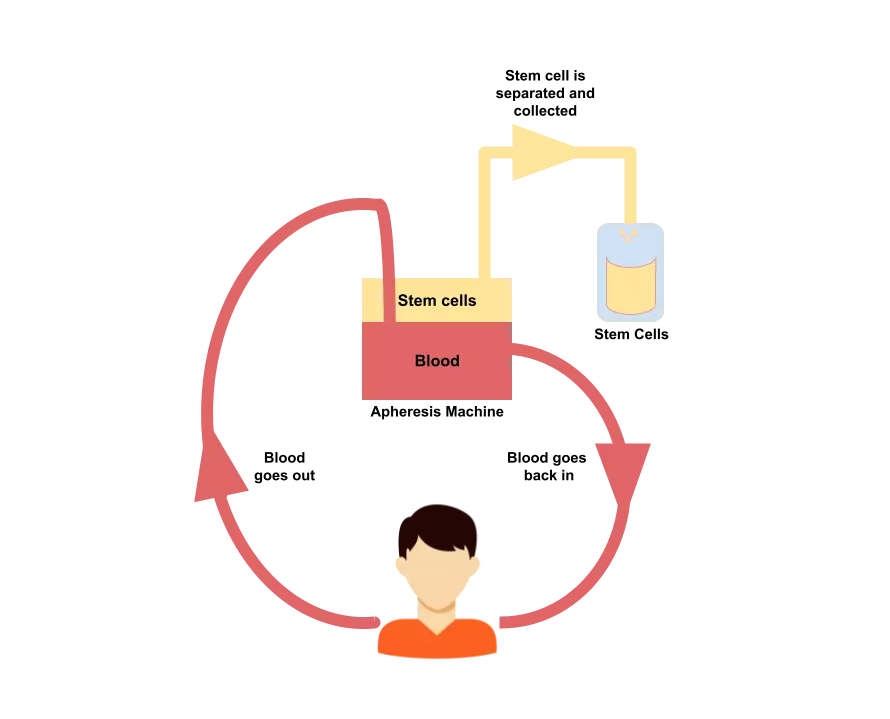
During apheresis, blood passes through a specialised machine that separates and collects stem cells before the remaining blood is returned to your body.
A growth factor called Granulocyte Colony Stimulating Factor (GCSF) will be given daily for approximately four days to increase circulating stem cells. This is known as stem cell mobilisation.
On the day of stem cell collection, your haematologist will order a blood test to assess the number of circulating CD34+ stem cells.
Once the CD34+ count is adequate, a central line may be inserted into a large vein under local anaesthesia. The line can be used for blood tests, stem cell collection, fluids and medications.
The apheresis machine is connected to the central line. Blood passes through the machine, where stem cells are separated and collected before the remaining blood is returned to your body.
Collected stem cells are prepared in sterile bags and frozen in a specialised haematology laboratory. Additional collection may be needed if the amount collected is insufficient.
The frozen stem cells are kept according to specific laboratory requirements until they are required for your transplant.
Once the central venous catheter is removed and your clinical condition allows, you may return home and continue follow-up as an outpatient while the transplant date is arranged.
Conditioning treatment takes place before the stem cells are returned to your body.
During conditioning, you will undergo high-dose anti-cancer treatment aimed at reducing or destroying remaining cancer cells.
High-dose chemotherapy is administered over several days, usually through your central line.
After conditioning is completed, you will be prepared for the stem cell infusion. You will be closely monitored in a specialised isolation room while your immune system recovers.
The day your stem cells are infused is known as Day Zero. Recovery is measured from this day onward.
Stem cell infusion will usually take place approximately one to two days after conditioning treatment.
You may receive pre-medication, such as paracetamol and antihistamines, before the stem cell infusion to help reduce the possibility of a reaction.
The duration of the infusion depends on the number of stem cell bags required. Your nurse will monitor you throughout the infusion.
Your infusion day is referred to as Day Zero, which becomes the reference point for measuring your recovery.
Recovery varies between patients. Your transplant team will determine when it is appropriate for you to leave hospital.
After the transplant, the engraftment period begins. This is when the transplanted stem cells start growing and producing healthy blood cells.
During this period, your immune system will be significantly suppressed. You may remain in a hospital isolation room for approximately three to four weeks for close monitoring and recovery. Blood transfusions or medications may also be required.
Once your immune cell counts improve sufficiently, your haematologist may allow you to return home with medications and a scheduled follow-up appointment.
Even after discharge, your risk of infection may remain higher than usual, and additional precautions will be important.
Depending on your recovery, you may be advised to maintain similar infection-prevention measures for several months following the transplant.
Beacon Hospital's haematologists, BMT nurse coordinators and multidisciplinary specialists work together to support you and your family throughout the bone marrow transplant journey.
Our team can help you understand the treatment process and connect you with our Clinical Haematology specialists.