

beacon hospital logo

Endoscopic Ultrasound (EUS)

Home / Services / Endoscopic Ultrasound (EUS)

What is Endoscopic ultrasound (EUS)?

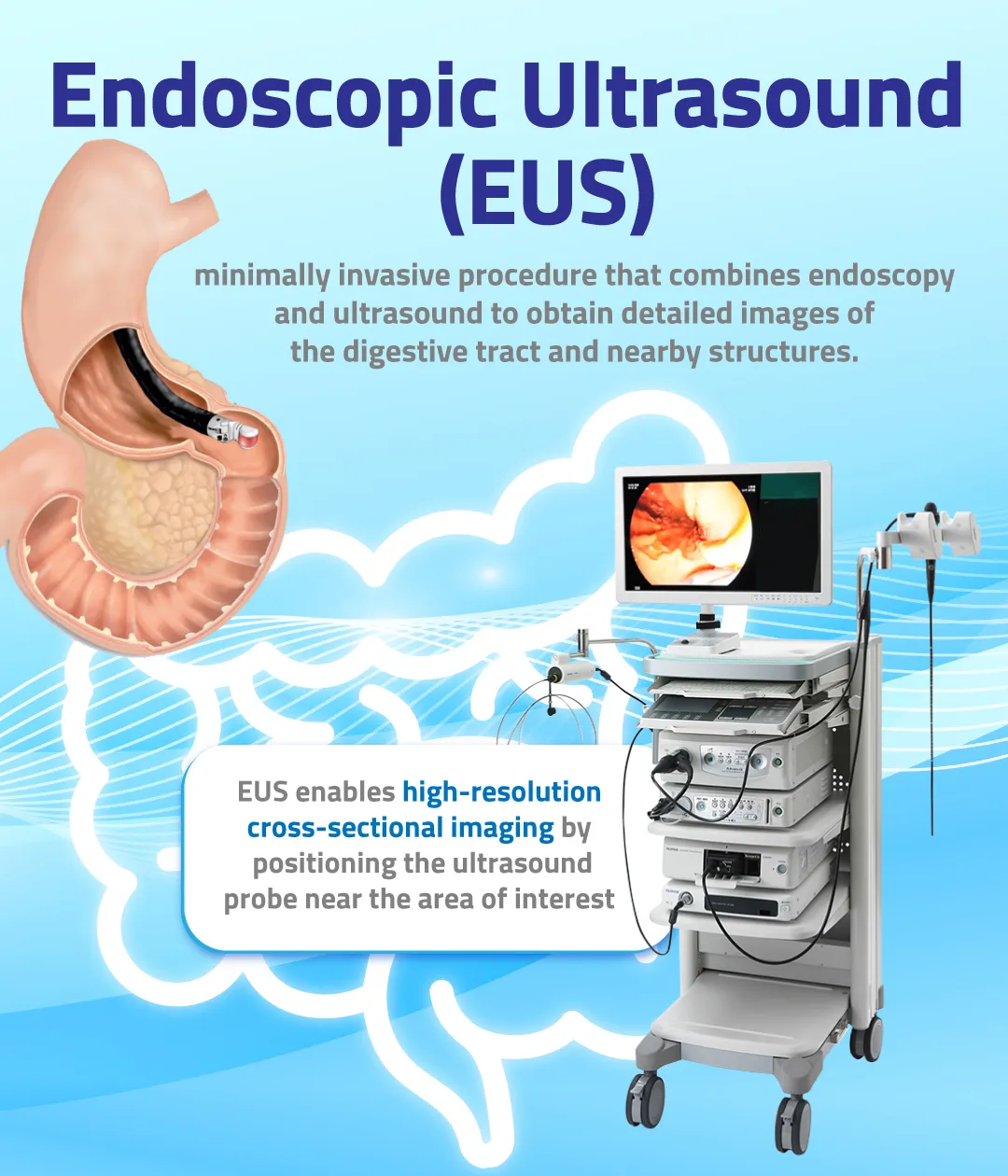
Endoscopic Ultrasound, also known as EUS, is a minimally invasive procedure that combines endoscopy and ultrasound to obtain detailed images of the digestive tract and nearby structures.
During the procedure, a thin and flexible tube called an endoscope is passed into the digestive tract. A small ultrasound probe at the tip of the endoscope produces real-time images from inside the body. This allows the doctor to examine not only the inner lining of the digestive tract, but also the wall of the digestive tract and surrounding organs in greater detail. 

What can EUS examine?

EUS may be used to examine a range of organs and surrounding structures, including the:
  • Pancreas
  • Bile ducts
  • Gallbladder
  • Liver
  • Lymph nodes
  • Upper digestive tract
  • Selected nearby chest or abdominal structures, including the mediastinum
Because the ultrasound probe is positioned closer to the area being examined, EUS may provide detailed cross-sectional images that support further clinical assessment.

When might EUS be considered?

A doctor may consider EUS when further assessment is needed after symptoms, blood test results, imaging findings, or endoscopy findings suggest an abnormality that requires closer evaluation. Depending on the clinical situation, EUS may be used in the assessment of:
  • Pancreatic lesions or pancreatic cysts
  • Bile duct stones or bile duct abnormalities
  • Subepithelial lesions in the digestive tract
  • Abnormal lymph nodes
  • Neuroendocrine tumours
  • Selected cancers involving the oesophagus, stomach, colon, rectum, pancreas, lungs, or ampulla
  • Pancreatitis
  • Abnormal findings seen on CT scan or MRI
  • Certain disorders affecting the rectum and anal canal
The suitability of EUS depends on the patient’s condition and the doctor’s assessment. 

How is EUS used in diagnosis and clinical management?

EUS may be used as part of diagnosis and, in selected cases, for image-guided procedures.
For diagnostic purposes, EUS may help doctors:
  • Obtain detailed images of internal structures
  • Assess the extent of selected abnormalities
  • Evaluate nearby lymph nodes or surrounding structures
  • Guide tissue or fluid sampling from certain areas when required
In selected cases, EUS may also be used for procedures such as:
  • Fine needle aspiration or tissue sampling
  • Drainage of pancreatic pseudocysts or collections
  • Gallbladder drainage in selected situations
  • Access to the bile duct when conventional ERCP is unsuccessful
  • Celiac plexus block or neurolysis for pain management in selected patients
  • Placement of fiducial markers for treatment planning
The use of these procedures depends on the clinical indication and the treating doctor’s judgement.

What are some possible advantages of EUS?

EUS may offer several clinical uses, depending on the reason it is performed. These may include: 
  • Detailed imaging of the digestive tract and nearby organs
  • Assessment of abnormalities that may require further investigation
  • Support for tumour staging in selected cases
  • Guidance for tissue sampling from certain areas
  • A minimally invasive approach in appropriate situations
Your doctor will advise whether EUS is suitable and what information it may provide in your case. 

How should I prepare for an EUS?

Preparation may vary depending on the reason for the procedure and whether tissue sampling is planned. 
In general, patients are usually asked to fast before the procedure. Your doctor may also advise you on medication adjustments, especially if you are taking blood thinners, diabetes medication, or other regular medicines. 
Please inform your doctor about:

1. Your Current Medications

2. Any Allergies
3. Your Medical History
4. Any Previous reactions to sedation or procedures
If additional preparation is required, your care team will provide further instructions before the procedure.

What happens after the procedure?

After the procedure, you may feel drowsy if sedation has been used. Rest is usually advised for the remainder of the day. 
Some patients may notice mild throat discomfort, bloating, or temporary abdominal discomfort after the procedure. Depending on the type of sedation given, you may need someone to accompany you home. 
Your care team will advise you on recovery, follow-up, and when normal activities may be resumed. 

Frequently Asked Questions

EUS is used to examine the digestive tract and nearby organs in greater detail. It may also be used to guide tissue or fluid sampling in selected cases.

A standard endoscopy mainly examines the inner lining of the digestive tract. EUS combines endoscopy with ultrasound so that deeper layers and surrounding structures can also be assessed.

Sedation is commonly used, so discomfort is usually limited. Some patients may experience mild throat irritation, bloating, or temporary discomfort afterward.

The procedure usually takes about 30 to 60 minutes, depending on the indication and whether additional procedures are performed.

Initial findings may sometimes be discussed after the procedure. If a tissue sample is taken, the final result may take a few days.

EUS is generally considered a low-risk procedure, but complications can occur. Your doctor will explain the possible risks, benefits, and limitations before the procedure.

Speak to Our Team

If you have been advised to undergo an Endoscopic Ultrasound or would like to understand whether EUS may be appropriate for your condition, speak to your doctor or contact Beacon Hospital for further information. 

Schedule An Appointment Today

More Contact Information

Email:

Whatsapp:

Office Hours:

Monday – Friday
8:30 AM – 6:00 PM

Chat with our Medical Enquiry Team.

start-chat-whatsapp-button-beacon-hospital-malaysia

Information

Visiting Hours:
10:00 – 22:00
General Line:
+603 7620 7979 +603 7787 2992
Consultants Appointment Line:
+603 7118 7878 +6012 328 6913
Email:
info@beaconhospital.com.my
Career Enquiries / HR:
joinus@beaconhospital.com.my

Beacon Hospital Sdn. Bhd.

200301019556 (621976-D)
1, Jalan 215, Seksyen 51,
Off Jalan Templer,
46050 Petaling Jaya, Selangor.

Subscribe to Our Newsletter

Stay up-to-date with the latest healthcare trends, expert advice and latest events at Beacon Hospital.

Subscribe to Our Newsletter

Stay up-to-date with the latest healthcare trends, expert advice and latest events at Beacon Hospital.
© 2026 Beacon Hospital (寶康医院). SDN. BHD. 200301019556 (621976-D) | (KKLIU 0573/2028)